- Version 1.0
- |
- Last updated 4th August 2026
Social Conflict and Control, Protest and Repression (Spain)
Introduction
Until very recently, there has been a dearth of research on the effect of the Great War on Spain. Significantly more literature has been published subsequent to the centenary of the outbreak of the Great War, with an emphasis on its ideological, political, and social implications. Contributors to the revision of the conflict’s significance include Francisco José Romero Salvadó, Maximiliano Fuentes Codera, Paul Aubert, Fernando García Sanz, Eduardo González Calleja, and Carolina García Sanz. Spain did not remain indifferent; rather, it was a secondary stage in the conflict between pro-Allied and pro-German forces, common to other neutral nations. Moreover, new approaches have enhanced the understanding provided by Juan Antonio Lacomba, who examined the importance of 1917 for Spain. The book by David Martínez i Fiol and Joan Esculies, as well as the exceptional collective volume edited by Eduardo González Calleja, analyze the reasons why Spain did not ultimately evolve towards democracy after that year. Also worth mentioning is the book by Roberto Villa, who argues that an attempted revolution occurred in 1917 aiming to overthrow the Spanish monarchy.
The objective of this entry is to examine the extent to which the Spanish political regime, the so-called Restoration system, was aggravated by the Great War, particularly during the 1917 crisis, despite not being a determining factor in its demise. Its primary goal is to address the current dearth of research on the significant role played by the Cantabrian provinces (Asturias and the Southern Basque Country) during this period. The social and political division resulting both from international polarization, i.e. sympathies towards the warring sides, and from the economic impact of the military conflict and its pivotal influence on social upheaval will also be examined. This entry will also comment on the evolution of Spain in the post-war period. The end of the war dashed the hopes of those who believed that the victory of the Triple Entente would lead to the democratization of Spain. In the post-war period, the traditionalist right and even King Alfonso XIII (1886-1941) made no secret of their sympathies for a dictatorship, which eventually culminated in the September 1923 coup by Miguel Primo de Rivera (1870-1930).
Social and Political Division
Although Spain was militarily neutral during the Great War, various political forces wanted to support one of the two warring sides. The widespread view was that an Entente victory would bring about a new liberal and democratic world, while a German triumph would benefit the conservative parties and enable the expansion of conservative monarchies throughout Europe.
Neither the pro-Allied bloc nor the pro-German one were homogeneous; that is, there were pro-German liberals and pro-Allied conservatives. However, in general terms, Germanophilia was supported by the new Maurist conservatives and many Carlist Legitimists, while pro-Entente sentiment or Francophilia enjoyed broad support among the liberals led by the Count of Romanones (1863-1950), the reformist Melquíades Álvarez (1864-1936), the republican Alejandro Lerroux (1864-1949), and most socialist and many anarchists. Although many anarchists refused supporting either warring side and even organised a congress in favor of neutrality (Ferrol, 1915), many others showed their support for the Triple Entente. Virtually overlooked today, both Asturias and the Basque Country played an important and unique role.
Among other Reformist media in Asturias, the newspaper El Noroeste, which had been operated by Antonio López-Oliveros (1878-1967) since 1917, was a significant advocate for Melquíades Álvarez’s ideas and became one of the principal champions of the Entente cause. Reformist leaders, such as José Manuel Pedregal Sánchez (1871-1948), (future Minister of Finance) and Santiago Innerarity Cifuentes (1875-1942) collaborated with the Entente through coastal surveillance services. Socialist media such as La Aurora Social and anarchist publications such as Acción Libertaria also endorsed the Entente’s positions. For their part, the Germanophiles had the support of the Oviedo-based clerical newspaper El Carbayón, the traditionalist Gijón-based El Pueblo Astur, and, later, the Maurist El Correo de Asturias, which until 1916 had been liberal and pro-Entente. Pro-Entente associations were promoted in the region, including the Sociedad-Liga Aliadófila Ovetense and the branches of the Liga Antigermanófila in Oviedo and Gijón. Pro-neutrality Germanophile committees were formed throughout Spain, promoted by the newspaper La Nación.1 In the Amistad Hispano-Germana Manifesto (1915), 277 Asturian personalities signed, including forty lawyers, thirty-five merchants and industrialists, twenty-nine priests, twenty-three civil servants, twenty-one doctors, chemists and pharmacists, seventeen engineers, seventeen bankers, twelve university lecturers and teachers, ten students, five writers and journalists, three doctors and graduates, and sixty-five people whose profession could not be determined.2
The Basque Country presented a unique situation—similar only to Catalonia—where regionalists also enjoyed great political power. Conservative monarchists and Carlists generally supported the Central Powers, while liberals, socialists, and Basque nationalists (conservative Catholics) leaned towards the Entente. Basque nationalists believed that an Entente victory would extend the British model of home rule to the different nationalities of the Iberian Peninsula. They also believed that the United States would support the autonomy of the Basque Country, after President Woodrow Wilson’s (1856-1924) Fourteen Points Speech on 8 January 1918. The media participated in this very active civil war of words, which manifested as harshly criticising each other’s statements regarding the Great War. La Gaceta del Norte (Catholic conservative) and the nationalist newspaper Euzkadi in Biscay were starkly adversarial during these years. In Gipuzkoa, the Catholic Integrists of La Constancia furiously criticised France and showed unconditional support for Germany; conversely, the liberals of La Voz de Guipúzcoa defended the French government’s war policy, sent financial donations to wounded French civilians, and even celebrated the French national holiday on 14 July by singing the “Marseillaise.” In Álava, where the civil war of words was less intense, La Libertad (left-wing) teased the Carlists during 1915 and 1916 following the pro-Entente statements by Francisco Martín Melgar (1849-1926), who was secretary to Jaime de Borbón y Borbón-Parma (1870-1931), the Carlist pretender to the Spanish throne. On the other hand, Navarrese legitimists and conservatives—opponents of Basque nationalism—supported the Germans. The newspaper Diario de Navarra, a champion of Spanish military neutrality, went so far as to accuse Basque nationalism of supporting entry into the war alongside the Entente in the 1918 elections. Diario de Navarra organized numerous “neutralist campaigns,” associated the defense of military neutrality with right-wing parties and accused the rest of the political spectrum of pursuing a warmongering policy.
Comparable patterns of political polarisation and social impact were also observable in other key regions of Spain. In Catalonia, wartime economic expansion, inflation, and the strengthening of labor organizations coincided with political mobilization around regional reform initiatives, exemplified by the 1917 Assembly of Parliamentarians convened by deputies of the Lliga Regionalista. Although these efforts sought greater autonomy and constitutional reform, they were largely frustrated amid escalating social conflict and resistance from the central government. In the Canary Islands, Spain’s strategic position in the Atlantic made the archipelago a key site for maritime control and trade while the wartime Allied blockade and navigation restrictions disrupted commerce and communications.
Social Conflict and the Crisis of 1917
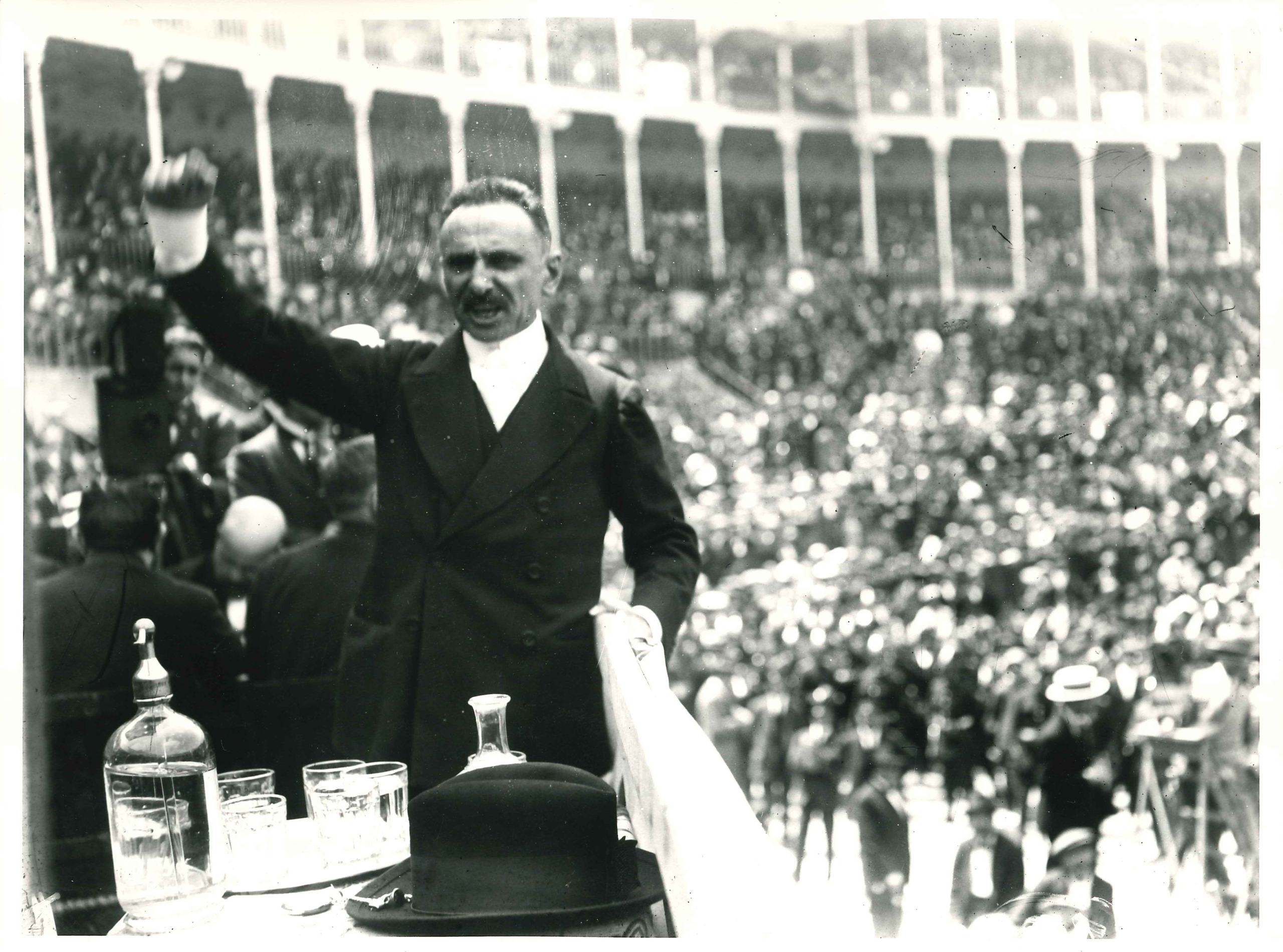
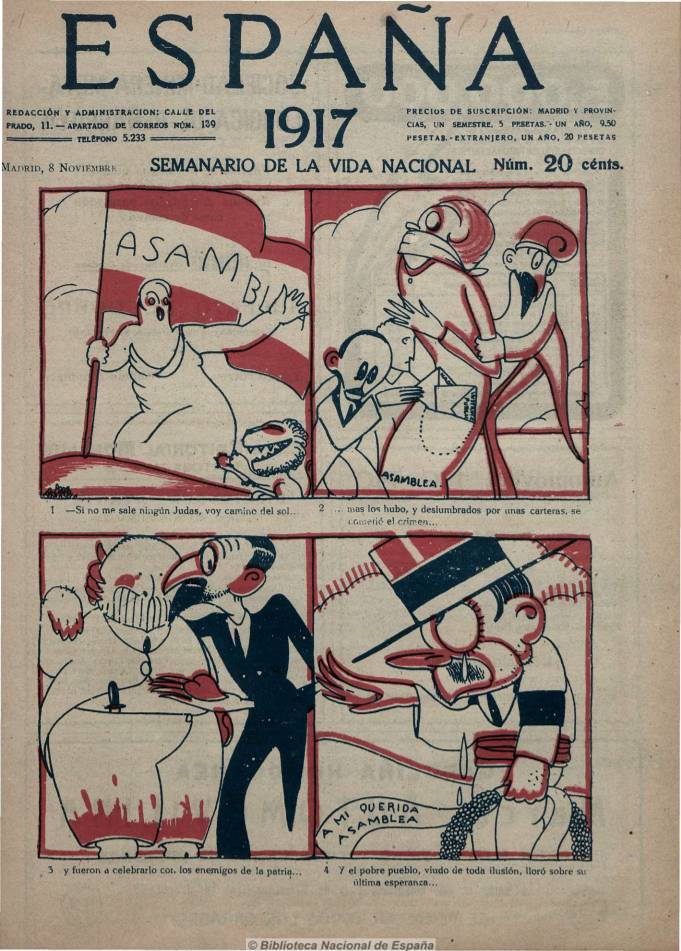
The year 1917 marked a significant milestone in European politics, as the Great War reached one of its zeniths. The Russian revolution triumphed that year, French soldiers mutinied, northern Italy was rocked by bloody strikes, and Spain was afflicted with a triple crisis (military, political, and labor). During this period, Alfonso XIII feared being dethroned and potentially suffering the same fate as Tsar Nicholas II (1868-1918). The formation of governments was influenced by the organization of critical sectors of the army into so-called Defence Committees. Moreover, in June 1917, King Alfonso XIII replaced a liberal government with a conservative one in response to the threat of a coup d’état. In addition, in July, an Assembly of Non-Dynastic Parliamentarians (excluding monarchist liberals and conservative deputies) was convened in Catalonia, demanding the reopening of Congress and parliamentary activity. The Spanish government also suppressed this assembly. Ultimately, in August 1917, a revolutionary general strike took place, demanding a change in the political regime and improved wages.
The revolutionary strike was significantly bolstered by economic hardship and social inequality. There were, however, some positive economic developments. The economy grew enormously, as shown by the 27 percent increase in agricultural production between 1913 and 19173 and the Bank of Spain’s gold reserves increased exponentially, from 720 million in 1914 to 2,554 in 1921, making it the fourth largest central bank in the world in terms of reserve volume. Nevertheless, the Silver Age of the Spanish economy did not prove beneficial the middle class or workers. The price index doubled between 1913 and 1918, while wages rose by only 25 percent and inflation during these years reached 22 percent per annum. Worse, the unemployment rate reached almost 50 percent in some regions, such as the mining area of Gallarta (Biscay), where 5,000 of the 12,000 workers were unemployed.4 Labor tensions were also evident in strategic sectors linked to foreign capital, particularly in the mining districts of southern Spain, where the British-owned Río Tinto Company Limited became a focal point of social conflict.
Protest and Repression
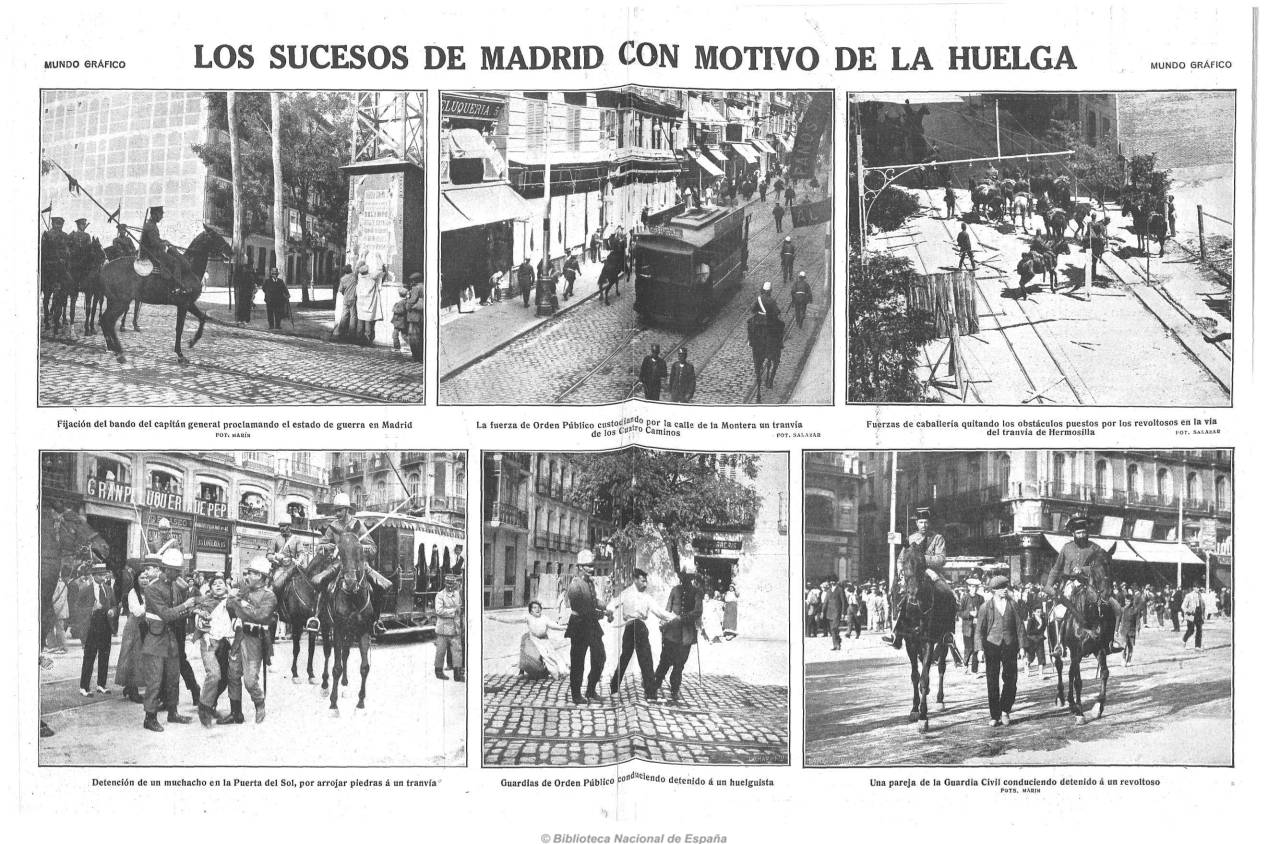
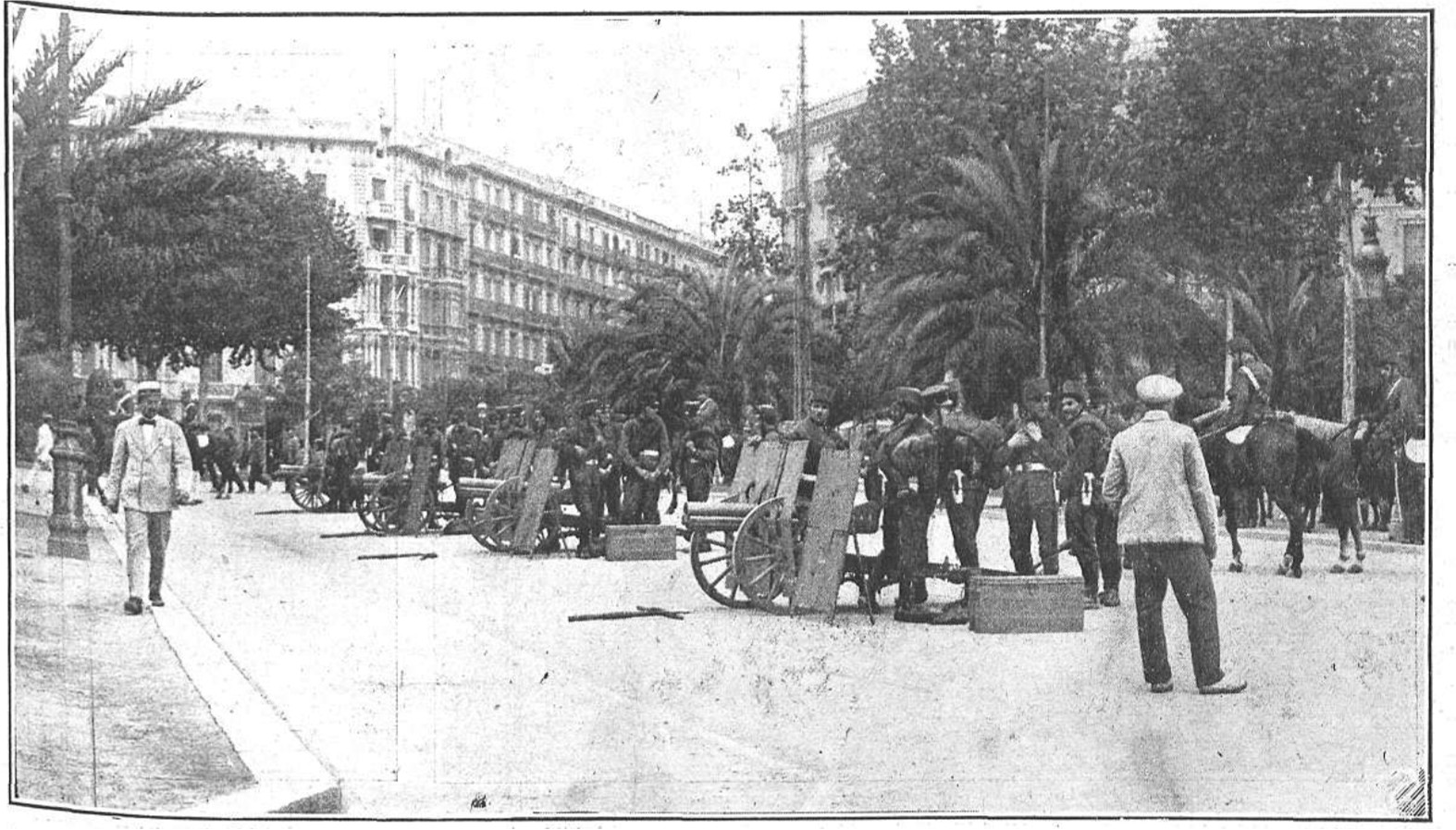
This troubled social situation led to widespread unrest, especially during 1916 and 1917. Following numerous isolated strikes throughout 1916, the two main trade unions, the General Union of Workers (UGT, socialist) and the National Confederation of Labor (CNT, anarchist), staged a joint strike in December of that year. Following the success of this protest, in March 1917 both unions announced their intention to launch an indefinite general strike. After several months of social tension and numerous isolated strikes in practically all sectors,5 the general strike finally began on 11 August, spurred on by a labor dispute with railway workers in Valencia. The strike, which was initially intended as a peaceful protest, became violent and was harshly repressed, particularly in the large cities.
Both strikes in Asturias were met with widespread support. It is important to note that since August 1914, there had been various protests against the subsistence crisis in both Gijón and the mining areas. These protests were in addition to demonstrations against the government’s restrictions on freedom of expression. Censorship was common throughout Spain, and newspapers were strictly regulated. These limitations were most evident during the general strikes and the most violent episodes of the Great War, specifically German submarine warfare on the Spanish merchant marine.6 This censorship was designed to prevent disputes between the pro-German and pro-Entente camps. Between 13 August and 7 October, Asturias had become the region with the most prevalent and significant labor conflict. Contemporary observers such as Canon Maximiliano Arboleya Martínez (1870-1951) noted that the workers’ action was initially characterized by a remarkable degree of restraint and absence of violence. Nevertheless, the army ordered the movement of a convoy along the railway, known as the “Train of Death,” which traveled between Pola de Lena and Ablana (a locality in Mieres), firing indiscriminately at women, children, and the elderly. Manuel Llaneza Zapico (1879-1931) even requested the distribution of leaflets to urging civilians to stay away from the tracks. The leadership of the mobilisation fell to the reformist Melquíades Álvarez, who assumed the presidency of the strike committee in Asturias at the express request of the socialist leader Pablo Iglesias (1850-1925). Besides Álvarez, the strike leaders included the head of the Asturian Miners’ Workers’ Union (SOMA), Manuel Llaneza, the socialist Teodomiro Menéndez (1879-1978), and the anarchist Eleuterio Quintanilla (1886-1966). As tensions rose, Álvarez sheltered Manuel Llaneza in his Oviedo villa, located on Silla del Rey Street.
The offices of El Noroeste in Gijón acted as headquarters for the movement, and the newspaper promoted subscriptions supporting the mobilization. Furthermore, anarchist sectors were planning the occupation of the North Station and several strategic points in Gijón and Oviedo. In an attempt to put an end to the strikes, Melquíades met repeatedly with military officer Ricardo Burguete (1871-1937), who oversaw the suppression of the strikes. The reformist movement experienced significant discord as a result of this collaboration and the conflict’s expansion. Ramón Álvarez Valdés (1866-1936) went so far as to say that he preferred “the tyranny of those above to that of those below.” Additionally, the Carlist deputy Juan Vázquez de Mella (1861-1928) accused the revolutionaries of receiving financial support from the Entente.
The Basque Country, an important industrial area, also experienced social turmoil. On 17 December 1916, disturbances during the joint strike by the UGT and CNT trade unions in Bilbao and San Sebastián were so serious that La Voz de Guipúzcoa was unable to be published on the next day. It is important to note that the middle classes were sympathetic to the strike. They had been hard hit by a cost of living crisis since 1914, which the ongoing efforts of local authorities, including the mayor of Bilbao Mario Arana (1884-1931) (mayor between 1916 and 1919), were powerless to resolve. The general strike of 1917 also enjoyed widespread support, and it too was harshly repressed. Charges were brought against the strikers in San Sebastián, and approximately ten individuals lost their lives in Bilbao, out of a total of seventy-one deaths across Spain. Because of Bilbao’s industrial importance, the government sent the León Regiment there to reinforce the Garellano Regiment. One soldier from the Garellano Regiment was killed, and five civilians lost their lives when a train derailed. An officer, Lieutenant Aníbal Boyer, even murdered a child, but was later court-martialled after the crime was reported by the socialist deputy Indalecio Prieto (1883-1862). Political leaders, including the socialist councillors of Pamplona Gregorio Ángulo (1868-1937) and Miguel Serdeño, were also impacted by the repression. The latter was tried in military court, while the deputy Prieto himself was forced to flee into exile in France for several months after his family was arrested. Conversely, in the more politically conservative provinces of Navarre and Álava, where fewer leftist workers lived, Spanish police easily quelled the development of the protest. Álava’s Provincial Council sent a message of congratulations to the military governor of the province.7
In the aftermath of the bloody strike, various collections were organized for the deceased. A campaign in favor of amnesty for the hundreds of detainees was organized, despite ongoing government repression efforts. A demonstration and rally in Bilbao evinced this. There, the repression failed to stop the protesters, who continued to demand amnesty, especially for the Committee itself, imprisoned for having organized the strike. The Committee members were sentenced to life imprisonment, although they were released six months later. The Spanish Socialist Workers Party (PSOE) put them forward as candidates for deputies in the February 1918 elections, and they were elected. This factor, together with persistent social pressure, contributed to the proclamation of an amnesty in May 1918.
“This is not about a government, but a system that is collapsing:” Post-War Impacts
As reflected in this headline written by Raimundo “Garcilaso” García (1884-1962), editor of Diario de Navarra, the war accelerated the crisis and the eventual fall of the Spanish Regime. Garcilaso, like other prominent politicians, advocated for a dictatorship, as did others, such as Vázquez de Mella, a Carlist and pro-German leader. Upon confronting the pretender Jaime de Borbón, Mella, a dissident, publicly advocated for a dictatorship in his new political organ El Pensamiento Español. The fear of revolution after the Spanish crisis of 1917, the Russian Revolution, and the failed German insurrection in November 1918 stimulated the emergence of aristocratic defence organizations including Acción Nobiliaria (Aristocratic Action) and Defensa Ciudadana (Citizen Defence). Furthermore, Spanish political parties were discredited and polarized, which prevented the formation of a stable government. The monarchy itself was impacted by the collapse of the old European monarchies in Central Europe. As mentioned above, Alfonso XIII’s fear of ending up like Tsar Nicholas II led him to significantly rethink his political position beginning in 1917. The former regenerative monarch adopted a clearly counter-revolutionary position, even flirting with authoritarian proposals. Additionally, in 1919, he dedicated Spain to the Sacred Heart of Jesus, a decision that clashed with the secularist aspirations desired by the liberal and left-wing political parties.
Wilsonian concepts also entered the debate. They not only gained attention in certain sectors of Madrid republicanism and Catalan nationalism, but they also penetrated other regions, including Asturias. In the immediate aftermath of the war, several local councils advocated for autonomist initiatives. Gijón and other municipalities argued for the need to transfer “the organising power of the state to the various capitals of the periphery.”8 In line with the reformist project, these proposals included the convening of a constituent assembly to decide on the form of government. This was also in part a response to the Germanophile aims of regionalism, represented by individuals such as Vázquez de Mella himself and the Viscount of Campo Grande (1855-1924). Basque nationalists firmly believed in the benefits of Wilsonism for their political cause. On 25 October 1918, the Basque Nationalist Party sent a telegram to President Woodrow Wilson, requesting his assistance in guaranteeing that nationalities’ rights would be respected upon the attainment of peace. The Basque nationalists also launched a petition for autonomy that was ultimately rejected by the Spanish Parliament.
Thus commenced a trajectory that met minimal opposition and led to the dictatorship of General Primo de Rivera (1870-1930) in the autumn of 1923. Between 1918 and 1923, the Restoration’s political system collapsed and even political outsiders, such as Francesc Cambó (1876-1947), who was one of the architects of the 1917 Parliamentary Assembly, participated in the government. Another revolutionary from the days of the Great War, Melquíades Álvarez, approached the liberal left again in the hope of achieving the effective democratization of Spain for which he had aimed via an Allied victory. It was in vain, as his advocacy for accidental forms of government was opposed by Alfonso XIII, who rejected any attempt to democratize the political system. Alvarez’s theory held that the specific form of government (monarchy or republic) was not essential, as long as the regime would be based on democratic, liberal, and constitutional principles. Moreover, the search for an “iron surgeon,” a dictator who could avert disaster, was further bolstered by the negative developments in the Rif War, including the disastrous Battle of Annual in the summer of 1921, for which the monarch himself appeared to be responsible, and the escalating social conflict in Catalonia. In Barcelona, for example, the CNT was opposed by the free trade unions (Carlist). In Asturias, the conflict pitted socialists against Catholic trade unions, with the events in Moreda standing out. There, eleven people died and Vicente Madera Peña (1896-1983), a prominent Catholic trade unionist and deputy during Franco’s dictatorship, played a conspicuous role. In southern Spain, particularly in Andalusia, post-war agrarian conflict reached unprecedented levels during the so-called “Bolshevik Triennium” (1918-1920). Rising prices, rural inequality, and revolutionary expectations inspired by events in Russia fueled mass strikes, land occupations, and confrontations between day laborers and landowners, prompting harsh repression by the authorities. These developments demonstrated that the social crisis accelerated by the Great War extended beyond the industrial centers and deeply affected Spain’s agrarian regions. In the Basque Region, right-wing politicians supported the creation of conservative parties, which enthusiastically welcomed Primo de Rivera’s dictatorship. Many individuals who had once defended pro-Allied positions, including Ramiro de Maeztu (1874-1936) and José Ortega y Gasset (1883-1955), eventually came to embrace authoritarianism. Miguel Primo de Rivera himself had once been a staunch supporter of the Allies.
Conclusion
The Great War was a military conflict that transformed the social and political reality of both the warring and the neutral countries. By 1917 it had intensified social contradictions and led to a general strike that made King Alfonso XIII fear for the end of his reign. Ultimately, it accelerated the fall of the political regime of the Spanish Restoration. It is highly probable that Primo de Rivera’s dictatorship would not have enjoyed such broad support without the King’s backing, nervous as he was about the effects of the Great War.
The fallout from the Great War in Spain (the “civil war of words” and revolutionary strikes) were also felt at a regional level, mainly in the highly industrialised areas: Asturias and the Basque Country. Subsequently, the war had a profound impact on the average citizen. The press organs of each political party echoed the social confrontation, which culminated in an attempted revolution that lasted approximately one week, and resulted in the deaths of seventy-one people and the injury of 156 others.
José Luis Agudín Menéndez, Universidad de Oviedo
Alejandro Pulido Azpíroz, Universidad del País Vasco
Notes
- Por la neutralidad/Comités de provincias, in: La Nación, 14 December 1916, p. 2.↑
- Amistad Hispano-Germana, Madrid, 1916: Tipografía La Académica Serra Hermanos y Rusell.↑
- Martorell Linares, Miguel: ‘No fue aquello solamente una guerra, fue una revolución’: España y la Primera Guerra Mundial, in: Historia y política 26 (2011), p. 25↑
- La falta de subsistencias, in: El Socialista, 15 April 1915, p. 1.↑
- Even hairdressers in Bilbao went on strike in July: Movimiento societario, in: El Liberal, 25 July 1917, p. 2.↑
- For instance, Lo que no podemos decir and El restablecimiento de las garantías. Se acabó la previa censura, in: La Gaceta del Norte, 12 July 1917 and 22 April 1917, p. 1 and p. 1. Contra la previa censura. La dignidad de la prensa, in: El Liberal, 28 July 1917, p. 1.↑
- Telegram, 23 August 1917, Plenary sessions. 8/6/1917- 14/12/1917, Archive of the Historical Territory of Álava.↑
- Plenary Municipal Minutes, session of 8 November 1918, Municipal Archive of Gijón, pp. 143–146.↑
Selected Bibliography
- Acosta López, Alejandro: Aliadófilos y germanófilos en el pensamiento español durante la Primera Guerra Mundial. Balance historiográfico de una Guerra Civil de palabras (Allied sympathisers and German sympathisers in Spanish thought during the First World War. A historiographical assessment of a ‘Civil War of words’), in: Studia Historica. Historia Contemporánea 35, 2017, pp. 339-367.
- Agudín Menéndez, José Luis: Reconsideraciones sobre el impacto de la I Guerra Mundial en Asturias: de las visitas culturales francesas a las celebraciones del triunfo aliado (Reflections on the impact of the First World War on Asturias: from French cultural visits to the celebrations of the Allied victory), in: Cabal Tejada, Rubén (ed.): «Aller-retour»: Las transferencias culturales entre España y Francia (siglos XIX-XX), Gijón 2023: Ediciones Trea, pp. 105-126.
- Agudín Menéndez, José Luis: Una guerra civil incruenta. Germanofilia y aliadofilia en Asturias en torno a la I Guerra Mundial (1914-1920) (A bloodless civil war. Sympathy for Germany and the Allies in Asturias during the First World War (1914–1920)), Oviedo, 2019: RIDEA.
- Erice Sebares, Francisco Manuel: Entre la represión y el paternalismo: actitudes burguesas ante lo popular en la España de la Restauración (Between repression and paternalism: bourgeois attitudes towards popular culture in Restoration-era Spain), in: Uría, Jorge (ed.): La cultura popular en la España contemporánea: doce estudios, Madrid 2012: Biblioteca Nueva, pp. 131-152.
- Esculies Serrat, Joan / Martínez Fiol, David: 1917: El año en que España pudo cambiar (1917: The year Spain could have changed), Sevilla, 2018: Editorial Renacimiento.
- Fuentes Codera, Maximiliano: El wilsonismo en España: de la ilusión a la decepción (1917-1923) (Wilsonism in Spain: from hope to disappointment (1917–1923)), in: Ayer. Revista de Historia Contemporánea 140/4, 2025, pp. 21-45.
- Fuentes Codera, Maximiliano: España y Argentina en la Primera Guerra Mundial. Neutralidades transnacionales (Spain and Argentina in the First World War. Transnational neutralities), Madrid, 2022: Marcial Pons.
- García Piñeiro, Ramón: Volver al 17 después de cumplir un siglo (Back to 17 after a century), in: Atlántica XXII 51, 2017, pp. 43-47.
- González Calleja, Eduardo (ed.): Anatomía de una crisis: 1917 y los españoles (Anatomy of a crisis: 1917 and the Spanish), Madrid, 2017: Alianza Editorial.
- González Calleja, Eduardo / Aubert, Paul: Nidos de espías. España, Francia y la Primera Guerra Mundial, 1914-1919 (Nests of spies. Spain, France and the First World War), Madrid, 2014: Alianza.
- Lacomba, Juan Antonio: La crisis española de 1917 (The Spanish crisis of 1917), Madrid, 1970: Editorial Ciencia Nueva.
- López-Oliveros, Antonio: Asturias en el resurgimiento español (apuntes históricos y biográficos) (Asturias in the Spanish resurgence (historical and biographical notes)), Gijón, 1982: Silverio Cañada.
- Martorell Linares, Miguel Angel: 'No fue aquello solamente una guerra, fue una revolución'. España y la Primera Guerra Mundial ('It wasn’t just a war, it was a revolution'. Spain and the First World War), in: Historia y Política 26, 2011, pp. 17-45.
- Moreno Luzón, Javier: El rey patriota: Alfonso XIII y la nación (The patriotic king: Alfonso XIII and the nation), Barcelona, 2023: Galaxia Gutenberg.
- Ponce Marrero, Javier Francisco: El bloqueo aliado y el control de la navegación en Canarias durante la Primera Guerra Mundial (The Allied blockade and control of shipping in the Canary Islands during the First World War), in: Vegueta, 1992, pp. 137-148.
- Pulido Azpiroz, Alejandro: Neutralidad en pie de guerra. El País Vasco y Navarra ante la Primera Guerra Mundial (1914-1918) (Neutrality on a War Footing: The Basque Country and Navarre in the Face of the First World War (1914–1918)), Madrid, 2021: Sílex.
- Romero Salvadó, Francisco J.: Spain 1914-1918. Between war and revolution, London, 1999: Routledge.
- Smith, Angel: Cataluña y la Gran Guerra: de la reforma democrática al conflicto social ( Catalonia and the Great War: from democratic reform to social conflict), in: Hispania Nova, 2017, pp. 472-499.
- Uría González, Jorge: La crisis de la Restauración (1898-1931) (The Restoration Crisis (1898-1931)), in: Fernández Conde, Francisco Javier / Javier, Francisco (eds.): Historia de Asturias, Oviedo 1990: Prensa Asturiana, pp. 773-788.
- Villa García, Roberto: 1917. El Estado catalán y el soviet español (1917. The Catan state and the Spanish soviet), Barcelona, 2021: Espasa.